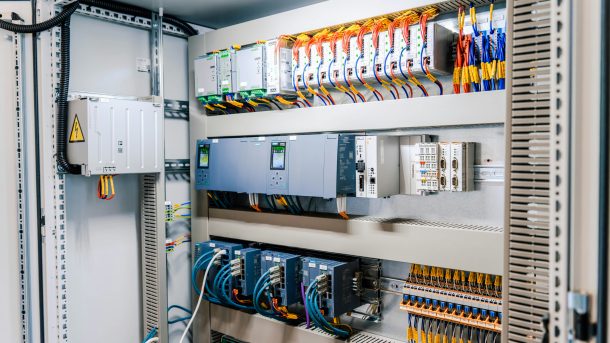
Photo by Raymond Sime on Unsplash
IT and OT cybersecurity are closely related, but they protect different environments and require different security approaches.
- IT Cybersecurity (Information Technology)
IT security protects data, applications, and business systems.
Examples:
- Laptops, servers, and databases
- Cloud platforms and business applications
- Corporate networks and email systems
- Identity and access management
Key priorities: Confidentiality, Integrity, and Availability (CIA).
Common threats include ransomware, phishing, data breaches, and credential theft.
- OT Cybersecurity (Operational Technology)
OT security protects systems that monitor and control physical processes in industrial environments.
Examples:
- PLCs (Programmable Logic Controllers)
- SCADA systems
- DCS (Distributed Control Systems)
- HMIs, sensors, and industrial controllers
- Manufacturing and production equipment
Key priorities: Safety, Availability, Reliability, and Process Integrity.
Common threats include unauthorized changes to control logic, disruption of industrial processes, and compromise of remote access.
- Key Differences
IT incidents can cause data loss, financial damage, and business disruption.
OT incidents can also stop production, damage equipment, affect the environment, or create safety risks.
Carefully evaluate patching, rebooting, and active vulnerability scanning in OT environments because they can disrupt critical industrial processes.
- Why IT/OT Convergence Matters
As industrial environments become more connected, compromised IT systems can create pathways into OT networks.
Effective protection requires network segmentation, restricted remote access, continuous monitoring, secure configurations, and coordinated incident response.
Standards and guidance such as IEC 62443 and NIST SP 800-82 help organizations develop appropriate industrial cybersecurity practices.
The Bottom Line
IT protects digital business operations.
OT protects physical industrial operations.
Both are essential, and securing them requires collaboration between IT, cybersecurity, engineering, and operations teams.