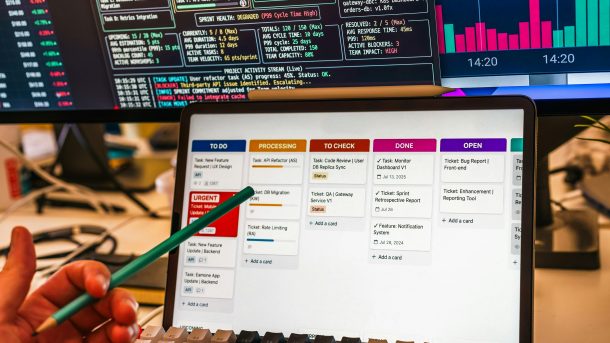
Photo by Jakub Żerdzicki on Unsplash
As cyber threats grow more sophisticated, organizations must strengthen their defenses to protect sensitive data and maintain operational integrity. At the center of this defense is the Security Operations Center (SOC), staffed by dedicated SOC analysts. But what exactly is a SOC analyst, and how is their role evolving with new technologies like artificial intelligence (AI)?
This article clarifies a SOC analyst’s responsibilities and explores how AI is transforming the modern SOC to address today’s dynamic cybersecurity challenges.
What Is a SOC Analyst?
A SOC analyst is a cybersecurity professional who monitors, detects, and responds to security incidents within an organization’s IT infrastructure. They serve as the frontline defenders against cyber threats, working within the SOC to safeguard the organization’s assets
SOC Analyst Meaning
The term “SOC analyst” encompasses various levels of expertise and responsibilities, often structured in tiers:
- Tier 1 SOC Analyst: Focuses on initial incident triage, monitoring alerts, and identifying potential security incidents.
- Tier 2 SOC Analyst: Performs deeper analysis of validated incidents, using advanced SOC tools and methodologies to assess scope and impact.
- Tier 3 SOC Analyst: Specializes in threat hunting, coordinating incident response, and developing long-term security strategies.
Integrating artificial intelligence into the SOC is reshaping SOC analysts’ roles and helping address many of the challenges they face.
AI SOC Solutions
AI SOC solutions use machine learning and AI algorithms to analyze vast amounts of data faster and more accurately than humans can. They identify patterns and anomalies that may indicate a security threat.
SOC Automation
SOC automation uses AI to automate repetitive, time-consuming tasks, such as log analysis and initial incident triage. This automation lets SOC analysts focus on more complex, strategic work.
Enhanced Incident Triage and Response
AI tools can perform initial incident triage, assessing alerts for validity and severity. They can also suggest remediation steps, accelerating response.
Enrichment in Threat Intelligence
AI enhances threat intelligence enrichment by automatically gathering and correlating data from various sources. This gives SOC analysts comprehensive context on potential threats.
Benefits of AI Integration in the SOC
Reducing Alert Fatigue
By automating security alert analysis and filtering out false positives, AI reduces the number of alerts SOC analysts must investigate manually, alleviating alert fatigue.
Enhancing Efficiency and Accuracy
AI processes data at speeds unmatched by humans, increasing the efficiency of threat detection and response. It also improves accuracy by minimizing human errors.
Enabling Proactive Threat Hunting
AI can identify patterns and indicators of compromise that may not be apparent to human analysts, enabling more effective proactive threat hunting.
Supporting Skill Development
With AI handling routine tasks, SOC analysts have more time to focus on skill development and strategic initiatives, addressing the skill shortage by maximizing existing talent.
The Future of SOC Analysts in the Age of AI
Evolving Roles
As AI takes over routine tasks, SOC analysts will evolve into more strategic roles, focusing on:
- Advanced Threat Analysis: Investigating complex threats that require human intuition and expertise.
- Security Strategy Development: Designing and implementing security architectures and policies.
- Collaboration and Communication: Working across departments to enhance organizational security awareness.
Embracing Continuous Learning
SOC analysts will need to continually update their skills, learn to work alongside AI tools, and understand emerging technologies and threats.
AI as a Collaborative Tool
Rather than replacing SOC analysts, AI serves as a powerful tool that enhances their capabilities. The synergy between human expertise and AI efficiency leads to a more robust cybersecurity posture.
Conclusion
The SOC analyst role is more critical than ever in defending organizations against sophisticated cyber threats. Understanding the SOC analyst role, its responsibilities, and its importance provides insight into the backbone of modern cybersecurity operations.
Integrating AI SOC solutions and SOC automation is transforming the modern SOC. By reducing alert fatigue, improving efficiency, and enabling proactive threat hunting, AI lets SOC analysts focus on strategic initiatives that strengthen an organization’s security posture.
As the cybersecurity landscape evolves, embracing AI technologies is not just advantageous—it’s essential. Organizations that integrate AI into their SOC operations can better combat current and future cyber threats.